


Suzuki's MOQBA 2

Introduction
ESTAT Actuation is proud that our uniquely thin electroadhesive brakes offer entirely new solutions for old problems. Our rotary brakes enable never-before-seen products with revolutionary technology.
Enter: Suzuki's MOQBA 2, a four-legged mobility platform that can be configured for multiple use-cases: with a "motorcycle/ATV" mode, a "chair" mode and a "commercial" mode for making delivieries.
The Problem
The MOQBA 2 is a vehicle unlike any other, being both wheeled and quadrupedal. As such, it has highly unique braking requirements that simply cannot be met with conventional brakes.
If Suzuki were to use conventional mechanical brakes for all 23 of the MOQBA 2's joints:
-
it would add 24,900 grams of weight (roughly a bucket of cement) to the system.
-
the brakes would take up 4679 cm of internal space where ever cubic centimeter counts.
-
would require 314 watts of energy (enough to run a small refrigerator).


The Solution
ESTAT Actuation's Rotary Brakes, the lightest, most compact ever built.
They're modular, making increasing or reducing torque as simple as add or subtracting modules.
They're tunable, allowing designers to target precise sip toques.
And they are ridiculously power-efficient, allowing vehicles like the MOQBA 2 to enojoy much longer battery life than conventional brakes would.
The Benefits
Using ESTAT Actuation's Rotary Brakes drastically reduces these system requirements, allowing for cascading weight and power savings across the entire machine.
This removes the weight of a bag of cement, 23" of total joint length, and the need for enough power to run a small refrigerator!

Conclusion
Suzuki's design constraints and needs for the MOQBA 2 are unusual and require unique solutions. Fortunately, ESTAT Actuation's revolution electroadhesive technology support it.
The Ejection Scenario
During the catapult phase of ejection, the pilot can experience 12-15Gs of vertical acceleration. The head whips forward during the catapult phase, rebounds and then is subject to wind blast when they clear the cockpit which causes further whiplash. The LEET senses ejection and locks the tethers to stabilize the head during this violent event.
How it Works
The Future of the LEET-F
ESTAT is finishing the design of the LEET-F 2.0 which will feature multiple tethers and dramatically reduced size. This system will be subjected to mil-spec testing in Summer 2024.
Manikin testing will be performed at the 711th Human Performance Wing at Wright Patterson Air Force Base in Winter 2024. This testing will include the Vertical Deceleration Tower (right) which will subject the system to the accelerations experienced during ejection.
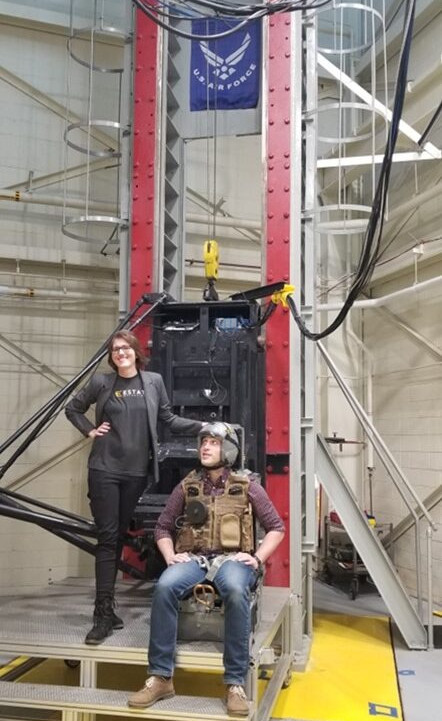
Dr. Kirby Witte, VP of Engineering, and Dr. Ben Shafer, Post-Doctoral Research Engineer, visit Wright Patterson Air Force Base to plan for manikin testing on the Vertical Deceleration Tower.

Dr. Ben Shafer, ESTAT’s resident kinesiologist and Research Engineer, experiences what it is like to be a Boom Operator inside the Boom Operator Simulator System (BOSS) at the 171st Refueling Wing with the help of Boom Operator and Trainer, Randy Reese.
The Future of ESTAT’s LEET Product Line
ESTAT plans to extend LEET protection to other members of the Air Force, specifically Boom operators on the KC-135. Boom operators have to maintain an extreme posture (see left) for hours on end. Using their neck muscles to support the weight of their heads for such long periods of time is severely taxing. This is another great application for ESTAT’s LEET.
We are excited to be working with Justin Jones, Innovation Officer at the 171st Refueling Wing, to promote a proposed LEET for Boom Operators, the LEET-B. We are also grateful for the support of Wing Commander Col. Hyland and are excited to be supporting our local Pittsburgh-based Air National Guard.
Reach Out
ESTAT is interested in learning more about careers with unique musculoskeletal risks. If you have a potential application for LEET technology and would like to discuss, let us know!